





Advanced production equipment​

Check out our manufacturing process​

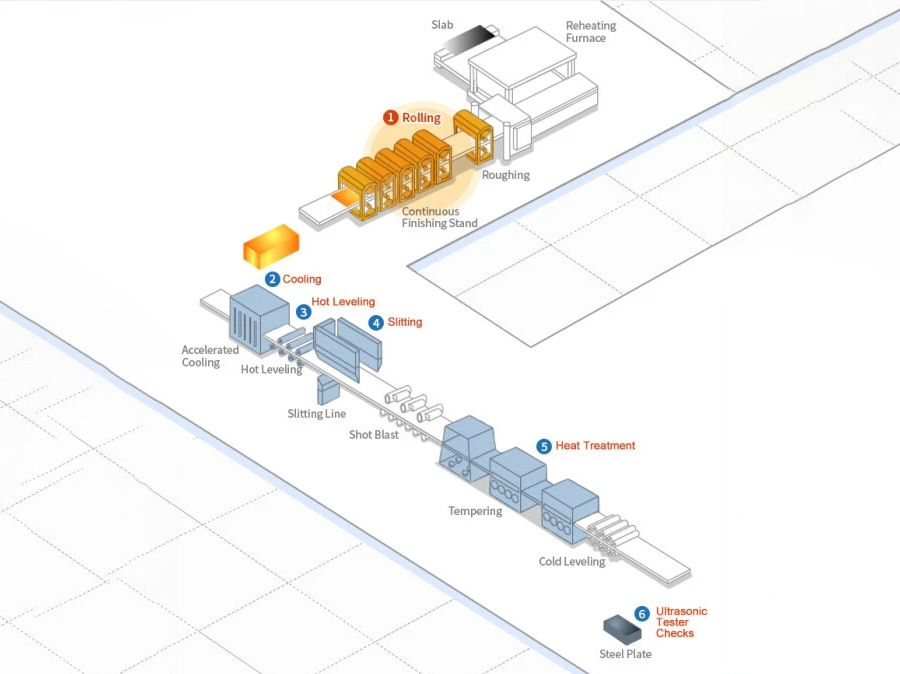
Steel Plate

  • 01.Rolling: 4-high reversible finishing mill (7000t max load) reduces internal defects in thick plates; automatic gauge & shape control cut thickness deviation and enhance flatness.
  • 02.Cooling: Suction-type mist cooling realizes heat-treatment-free high-strength steel, delivering strong cooling capacity and uniform widthwise temperature to lower quality deviation.
  • 03.Hot Leveling: Hot leveler removes residual stress for high-quality flat plates.
  • 04.Slitting: Plates are inspected dimensionally then cut by mechanical shearing or flame planing; parameters like air knife gap and nozzle size guarantee high dimensional accuracy.
  • Heat Treatment: Shot-blasted plates receive non-oxidizing radiant tube heat treatment for customer-defined structure and scale-free products.
  • 05.Ultrasonic Testing: Ultrasonic inspection identifies internal defects (blow holes, pipes, laminations) to meet customer quality standards.

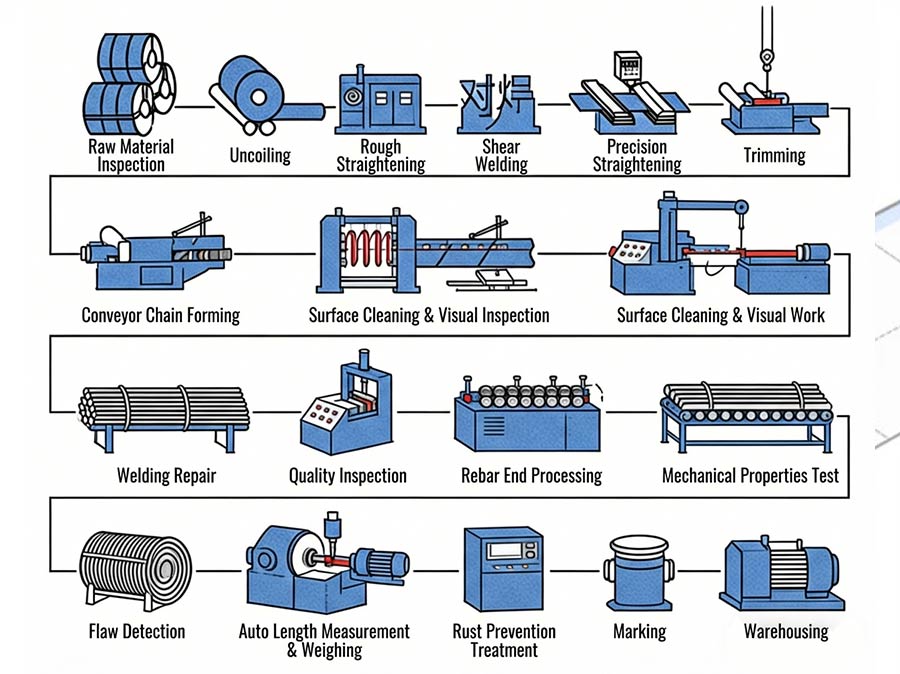
Rebar

  • 01.Rolling: Continuous rolling line with high-rigidity stands ensures stable dimension and roundness of rebar. Automatic gauge control and temperature monitoring systems effectively reduce diameter deviation and improve dimensional consistency.
  • 02.Temperature Control & Cooling: Controlled cooling and online accelerated cooling systems realize fine-grain strengthening through thermo-mechanical rolling, eliminating the need for extra heat treatment for conventional high-strength rebar. Uniform cooling across the cross-section reduces internal stress and avoids bending or cracking.
  • 03.Surface & Rib Forming: Precision pass design and rolling molds form standard transverse ribs and longitudinal ribs, guaranteeing reliable bonding strength between rebar and concrete. Surface defects such as scratches, folds and inclusions are controlled in the rolling process.
  • 04.Cutting & Sizing: After controlled cooling, bars are automatically measured and cut to fixed lengths by high-speed flying shears. Cutting length accuracy is optimized through servo control systems to meet construction and transportation requirements.
  • 05.Straightening & Finishing: Automatic straightening machines eliminate bending caused by rolling and cooling, ensuring straightness and straight-line performance. Surface oxide scale and burrs are removed to improve surface quality and appearance.
  • 06.Non-destructive & Quality Inspection: Online ultrasonic and eddy current testing detects internal flaws, surface cracks and hard spots. Tensile, bending and yield strength tests are conducted to verify mechanical properties, ensuring compliance with national and international standards.

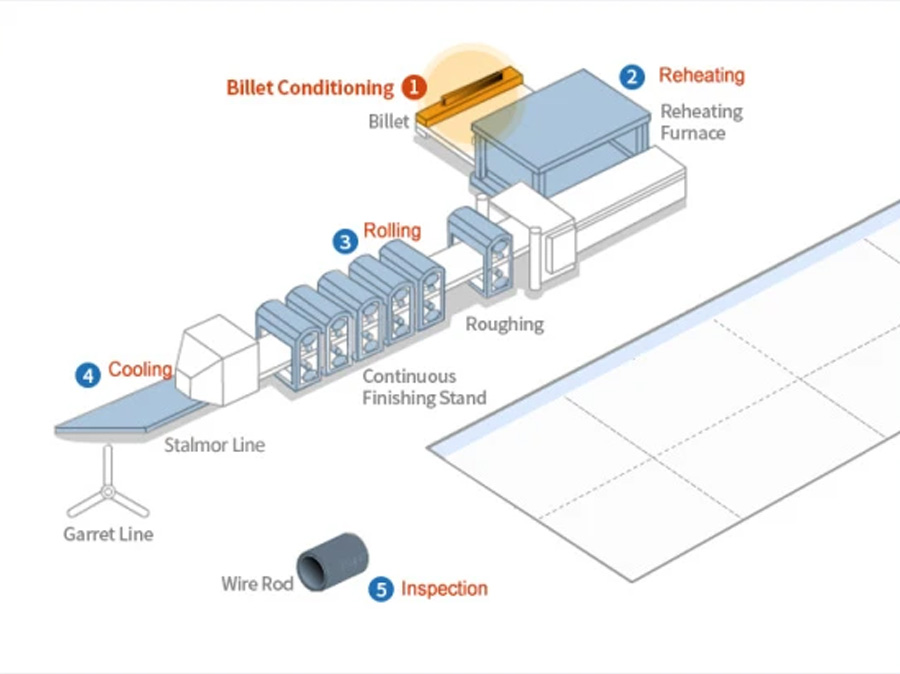
Steel Pipe

  • 01.Piercing & Rolling: The skew rolling piercer and continuous rolling mill perform hollow shell piercing and continuous forming, ensuring uniform wall thickness and roundness. Precision roll gap control effectively reduces eccentricity and wall thickness deviation.
  • 02.Sizing & Reducing: The stretch reducing mill carries out continuous sizing and diameter reduction at controlled temperature, stabilizing outer diameter and dimensional accuracy, and producing pipes with consistent geometry for various engineering applications.
  • 03.Cooling & Straightening: Online controlled cooling system stabilizes metallographic structure and lowers residual stress. Multi-roll straighteners eliminate bending and distortion, realizing high straightness and surface quality of finished pipes.
  • 04.Surface Treatment: Shot blasting and pickling remove oxide scale, rust and surface impurities. Anti-corrosion coating can be applied as required to enhance weather resistance and service life in harsh environments.
  • 05.Cutting & Machining: Pipes are cut to fixed lengths by flying shears or sawing machines. End facing, chamfering and threading are conducted to meet assembly, welding and connection standards in pipeline projects.
  • 06.Heat Treatment: Normalizing, quenching and tempering are applied to adjust microstructure and mechanical properties. Non-oxidizing heating furnaces are adopted to avoid decarburization and surface defects.
  • 07.Non-destructive Testing: Ultrasonic, eddy current and hydrostatic testing are implemented to inspect internal defects, surface cracks and sealing performance. Each qualified pipe meets pressure-bearing and safety requirements for oil, gas, pipeline and structural use.
Our Team

Expert-level technical engineer

Master Wang

Welder Extraordinaire

Master Li

Metal Sculptor

Master Zhang

Precision Welder

Master Zhou

Expert Joiner
well-known enterprise

Trustworthy partner

官网询盘
Contact for cooperation

Fill in your contact information

GET IN TOUCH

官网询盘